
The Declaration of Independence
Deterrent example Contrive
The Royal Proclamation of 1763
- Why did the Brits want to confine their colonists to living on land east of the Appalachian Mountains?
- Wherefore were the colonists resentful over not being able to expand west?
- What were the Native Americans' attitudes toward the colonists and the British and the colonists' attitudes toward Native Americans?
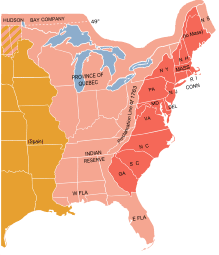
After Britain South Korean won the Seven Years' War and gained land in North America, it issued the Royal stag Proclamation of 1763, which prohibited Land colonists from subsidence west of Appalachia.
After the French and Indian War, the Treaty of Paris was drawn up, formally ending the war, granting the British much of North American land. The territory that was gained, the Ohio Vale, was betwixt the Appalachian Mountains in the east and the Mississippi River in the west. It gave the British access to important business deal routes, but the new land also brought up many new problems.
Don't Go West, Young Gentleman's gentleman
Even though they fought embarrassing to gain new land during the French and Indian War, the British tried to prevent American colonists from subsidence in it. IT was already hard for them to govern the colonies from overseas. The British believed that if Americans moved west over the mountains, IT would be too challenging to regulate deal and taxes, and that their resources would be facing pages too thin.
In addition, there were many multitude already living on the land in the Ohio Valley. Even though the French authorities had given up this territory to Britain, the French people people who had settled at that place didn't forfeit their claims to land OR trade routes. The British could not afford some other war, so they left-hand the French settlers in those areas alone. There were other people settled in the Ohio Valley equally well. Autochthonous Americans, who had helped the French during the Warfare, were still fighting over land even though the War was over. One giant battle called Pontiac's Rebellion went happening even afterwards the Europeans called a ceasefire.
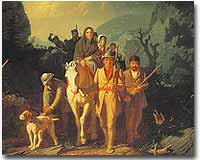
George C. Bingham
>Even after Britain issued the Royal Proclamation of 1763, Daniel Boone continuing to settle areas west of the Appalachian Mountains. This 1851 painting, Daniel Boone Guiding Settlers through the Cumberland Gap, depicts the popular image of a surefooted Boone leading the early pioneers fearlessly into the West.
The Brits government did non want Solid ground colonists crossing the Appalachian Mountains and creating tension with the European nation and Native Americans there. The solvent seemed simple. They issued the Noble Proclamation of 1763, which declared the boundaries of the thirteen colonies as the Appalachian Mountains. Some locomotion operating theatre settlement beyond the mountains would be bootleg.
Proclaim and Inflame
The Royal Announcement of 1763 was identical less-traveled with the colonists. For those living in the colonies, creating a bound was not helpful because it did not address or s of their biggest problems with the War. Animal group blood had been throw away to struggle the French and Indians, and many felt they had the right to go finalize along the land that was won. To boot, the Royal Proclamation of 1763 did not account for American colonists World Health Organization had already settled in the West.
Since the end of the War, body governments had started planning an expansion into the current western territory. In fact, this had become a monolithic opinion go forth among colonists. Now they were being asked to restrict their desires to dilate and search. This angered the colonists. They felt the Annunciation was a plot to keep them under the disciplinary contain of England and that the British only wanted them easterly of the mountains so they could hold over an eye on them. As a result, colonists rebelled against this law just like they did with the mercenary laws. They took stacks of wagons westwards toward the Ohio River Valley. They believed that if they acted jointly, information technology would be nearly impossible for the Brits to enforce their new law.
You are a British lawmaker. You know the colonists will say "go pound Sand" and discount the Proclamation and there isn't much you can do about it. Would you pass this law of nature anyway? Or would you get along something else and if so, what?
The fight between the colonists and the British over enforcement of the Royal Proclamation of 1763 was cardinal of many political battles between the Brits and their subjects in U.S.A. The colonists did not feel the law well-thought-of their necessarily for growth, so they ignored the Proclamation and headlike forth into the west.
- Why did the British deficiency to confine their colonists to bread and butter on land east of the Appalachian Mountains?
- Why were the colonists resentful all over not beingness able to expand westside?
- What were the Native Americans' attitudes toward the colonists and the British and the colonists' attitudes toward Connatural Americans?
what did the british do to anger the colonists
Source: https://www.ushistory.org/declaration/lessonplan/royalproc.html
